My dog ate my jury duty

cropped-prince-run.jpgI am writing this article as a bit of therapy. I will not include dates or details of the trial at hand, because they are not within the scope of this article. This is about my embarrassment as a potential juror. Hopefully this will assist you in the future.

I was called to jury duty, but was unfamiliar with the process. I was upset about the way the summons was issued because I was not even informed that I was in a period when I could be called. I will say that the court staff was extremely kind and understanding. That settled me quite a bit.

As potential jurors were dismissed, I eventually wound up in the jury pool. I had several problems. I provide health care assistance for another person and their family. I do not have transportation. Yes, in this day and age, I can afford neither a vehicle nor the insurance to cover it. Much less the gas.

I was offered a hotel room and was okay with that. As a reporter I was not sure if I reported on this particular case, but I found out I did not. So that was okay. I had to arrange for a care taker for my friend, however. The judge was kind enough to grant a short recess to arrange for a possible replacement. The transportation to get to the court house (about 35 miles away) was borrowed. I had to return it because it was used to transport my friend. Yet, if selected, I would not have that opportunity. One thing after another conspired against me.

As I was speaking—with the bailiff watching—I realized that I had no place to keep my dog. This fact was insurmountable. My dog would only stay with one other person for any length of time with comfort. That person was out of my life.

I believe that the bailiff saw the stress was just too much for me and informed the judge who eventually excused me.

You might be thinking Good job. You got out of jury duty. I see web sites with braggarts about their ducking their Constitutional responsibility.

You might also find it curious to find that I wanted jury duty. You see, I am a veteran. Over 17-years of my life was spent protecting and defending the very right to trial by a jury of my peers. To defend a person against unconstitutional incarceration—To prevent a person from being railroaded into jail—would be the epitome of my service in the Navy. Of course if guilty, getting a criminal off of the streets would also be important to me.

I am the guy Janet Napalitano warned you about. I am a veteran with a copy of the Constitution (usually) who knows how to use it. As Thomas Jefferson wrote to Thomas Paine in 1789:

I consider trial by jury as the only anchor ever yet imagined by man, by which a government can be held to the principles of its constitution.”

You may not be able to pick up a gun and kill an enemy. You may not be able to spend days on end under the sea. Not everyone can bring themselves to go into battle. Jury duty, however, is one area in which you can serve your country and preserve the Constitution without having to duck.

WHY IS TRIAL BY JURY IMPORTANT?

Imagine you come home from the graveyard shift. You are tired and you feel it is all right to leave the windows of your car open because you have another job to go to tomorrow and the summer days heat up quick. You hope that the interior of your car might just be cooler in the morning. You crawl off to bed for a restful night sleep.

At about 5 a.m., you are wakened by an incessant knocking at your door. You open it to find two police officers at your door. They inform you that there was a robbery and the alleged firearm was found in your backseat.

Who would you want as a juror? Someone who wants to serve? Or someone who is there simply because they could not come up with the right excuse?

At this point I would encourage you to find the movie Twelve Angry Men and watch it. Or read the play. [1] It is not only an entertaining film, but watch it for the lesson of what might transpire in the jury deliberation room.

Benjamin Franklin is oft quoted as writing: [2]

That it is better 100 guilty Persons should escape than that one innocent Person should suffer, is a Maxim that has been long and generally approved.

The “Maxim” was derived from an earlier quote by Voltaire:

that ’tis much more Prudence to acquit two Persons, tho’ actually guilty, than to pass Sentence of Condemnation on one that is virtuous and innocent.

In Commentaries on the Laws of England 9th ed., book 4, chapter 27, p. 358 (1783, reprinted 1978), Sir William Blackstone wrote:

“For the law holds, that it is better that ten guilty persons escape, than that one innocent suffer.”

Whatever “X” factor you wish to choose, the point is that trial by a jury of your peers has been guaranteed as a right since the Magna Carta of 2015; over 800-years ago.

So you would let a rapist or murderer go free? you might ask. I would not like to, no. Nor would I want to send a man to death row for thirty-years for murders he did not commit. If the prosecution cannot prove guilt beyond a reasonable doubt, you have to vote not guilty.

During the term of someone claiming to be governor of Arizona, the State created a guilty until proven innocent law. That law was used on Harold Fish [3] who was found guilty of defending his life. The law was reversed and grandfathered to his case. He was exonerated at a re-trial. The appellate court reversed the decision because:

In July 2009, the Arizona Court of Appeals reversed Fish’s conviction because the trial judge failed to give necessary jury instructions, and because the judge improperly excluded evidence of Kuenzli’s past acts of violence which Fish attempted to present to support his claim that Kuenzli was the aggressor.[4]

Now do you see the importance of your place on a jury? More importantly, do you see why it is important for you to understand your authority as a juror? Even though Arizona passed a guilty until proven innocent provision, you know that is unconstitutional. It flies in the very face of the basis of our justice system. You can vote to acquit. That includes courts at the local and, so-called, federal level. It only takes one.

In the case of Harold Fish, I would have been that one.

MY PROBLEMS WITH THE JURY PROCESS

I do have problems with the jury process as it is practiced today.  The Supreme Court has decided that it is not required that the courts instruct you on the power you actually have. Thus you will probably have to research the jury duty process for yourself.

During my research I found the Fully Informed Jury Association site. There is a lot of good information including a PDF on how to survive the Voir Dire process. The Voir Dire process is the process in which defense and prosecuting attorneys can eliminate potential jurors. Saying the least is the best.

The prosecutor in this case asked if our family or friends would call me a “conspiracy theorists.” Did anyone believe, for example, that we did not land on the moon. I raised my hand and the prosecutor asked if I really believed we did not land on the moon. I explained that I had seen the evidence and it was not conclusive. To set the record straight, I believe we landed on the moon because I neither have the time or inclination to examine the evidence.

My “conspiracy theories” are more along the lines of the erosion of our Constitution and Bill of Rights. The fact that windmills are more dangerous than good to our environment and wildlife. The fact that global warming has nothing to do with anthropomorphic C02, but simply the natural wobble of the earth on its axis. United Nations treaties targeted at destroying our Constitution and sovereignty as a nation. Things I can prove. Or disprove.

I have a problem with the courts not following the Seventh Amendment [5] which reads:

In Suits at common law, where the value in controversy shall exceed twenty dollars, the right of trial by jury shall be preserved, and no fact tried by a jury shall be otherwise re-examined in any Court of the United States, than according to the rules of the common law.

It does not say, …where the value in controversy shall exceed twenty dollars to be increased 6% per annum allowing for cost overrides and etc. ad nauseum, the right of trial by jury shall be preserved. It says twenty dollars. Admittedly you are probably not very bright if you are demanding a jury trial for a parking ticket.  After all you are likely in line for a warning or maybe a fine of less than $100. If you persist, you may wind up with much more. Especially since you will upset the people that had to be pulled in for jury duty.

The point is that if you demand a jury trial, you are due one. Especially in the case of the employees you hire called the government are trying to take your property that might be well over $20. It should be twelve of your peers.

I was concerned about a jury of less than eight of my peers. I have found evidence in my studies, however, that there were juries of less than twelve in the past. If there is the possibility of you spending more than a year in prison or a hefty fine that you obviously cannot afford (and, thus, have to make it up in prison), you need a jury of twelve of your peers.

PLAN AHEAD

So my advice is that if you are ever summoned for jury duty, plan ahead. Plan on being picked. In fact, call the clerk and tell them you want to be in the first venire or panel. Remember that if you serve, you will not be required to serve again for a certain number of years. In Arizona it’s two. Otherwise they can keep summoning you.

In my case, I did not understand that—if chosen—I would have to stay there for the duration. Or find away to travel the 70 miles back and forth each day. For the courts part, they offered me a hotel room which I immediately accepted.  I thought that I would be able to take the borrowed car home. I found out that I would not. Next time I will see if a person is going to, or can take me to, the city of the court in question and pick me up if I do not get selected.

As for my friend, there are free services to caretakers—even if you are not a family member. In other words, if I need a vacation or, say, need to do jury duty, the county would have provided a free substitute for the duration. I did not realize this until after I was excused.

As for my dog, I have a problem. There is only one person that he would stay overnight with comfortably and that person is no longer in my life.  It would be a stress on him to stay overnight with anyone else, much less three days (four including the day for jury selection). I would, however, arrange to have him stay with the closest person I know and he will have to suffer through. Have a trusted friend collect your mail daily and feed your cat or fish.

If you get summoned, just plan on getting selected. Especially if you are trying hard enough. Arrange for transportation if needed. Call the court and see if a taxi service is available. In my rural area this might not be an option.

Call the county or local offices and see if services are available to help you serve on jury duty. Aid in transportation or taking care of sick relatives. If you might be late for a bill payment, call the creditor or utility company and explain that you might be late because of jury duty.

Make your employer aware of your summons right away so that he can arrange to have that time frame covered. Employers are not required to pay for the time you spend at jury duty in most states, but they cannot fire you. It will be less stress on your employer if you arrange for a cover just in case.

The point is that you should want to serve on a jury. A Grand Jury might be a little more of a problem, but it is an important part of our jury process. In fact the Grand Jury has to pass the case onto trial. You might be able to stop a politically motivated case from even going to trial.



Lulu holiday savings until December 14th.

Right now you can save 25% off any book at LULU.com to a maximum of $50. Simply add the coupon code BUYMYBOOK305 when you checkout. This offer expires December 14, 2011. Some of these books are downloadable as PDFs.

For those who like the smell of paper in the morning, our recent Treatises on Warfare contains a collection of documents from various eras of warfare. Concerning the Militia is still available and contains a wealth of information on the Second Amendment to the Constitution of the United States.

We have recently added Essays on the Constitution of the United States by Paul Leicester Ford with additional material and editing by Glen C. Davis. The “government approved” Federalist Papers were not the final word on the subject. See what some of the other Federalists and Anti-Federalists had to say about this document and the Bill of Rights. This book comes in regular print and a large print edition.

The fictional suspense novel A Shroud of Evidence is also still available. It is now available at the iBookstore for your electronic device.

So take your pick and save up to $50 until December 14th.


Government Class book on sale.

Beware the ides of March or you might miss a good deal. From now until March 15, you can get 15% off of your order by entering IDES305 in the coupon section for your order. Maximum savings with this offer is $10. This is an offer from LULU.COM which reserves the right to modify or cancel the offer at anytime. Not available where prohibited by law. This book has been known to cause bleeding and convulsions in laboratory liberals.

The Government Class Book by Andrew Young was one of the text books used in class rooms throughout America to explain the Constitution. While William Rawles’ A View of the Constitution of the United States of America remains thoroughly a secular law book, Andrew Young explains government at all levels and how they intertwine. His work certainly takes a different view of “the Separation of Church and State.”

This work is also available as a download and can be downloaded by members of Freedom Torch.


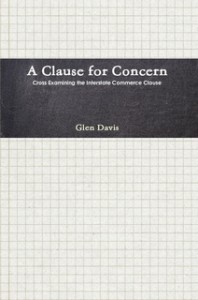
A Clause for Concern: Cross Examining the Interstate Commerce Clause

A Clause for Concern: Cross Examining the Interstate Commerce Clause

This is an examination of the Interstate Commerce Clause of the Constitution by a non-lawyer. Just how far does this Constitutional Power of Congress extend? What of other Constitutional authorities that the Congress has delegated or ignored?

The Congress has, for example, turned over control of the wealth of the nation to a cabal of private bankers collectively known as the Federal Reserve. Since 1913 this group has caused the Great Depression and has been directly linked to our current economic turmoil.

Does Congress have the right to order you to purchase health insurance? The Ninth Amendment to the Constitution should destroy that myth.

This is an attempt by a non-lawyer to make sense of it all, but I have dug down into some of the Supreme Court cases and evaluated them next to the Constitution.


The Government Class Book is now available.

Now available!

The Government Class Book, by Andrew Young (1865) is now available for purchase for $12.00 in 8 x 11 paperback. The download is $4.00.

The book is formatted tightly to reduce the number of pages. That is, there is very little margin space for notes. Later editions might add one or two pages for notes depending on the index. Speaking of the index, I added a quick one. I plan to revise it in later editions.

I have not read the entire work yet. However, it appears to go into much more detail concerning citizenship than just the Constitution. It covers many legal terms used and from where they are derived.

As a sample, the first section is entitled Principles of Government. In Chapter Two of that section, Rights and Liberty, defined, we read:

Sec.3. The rights here mentioned are natural rights. They are so called because they are ours by nature or by birth; and they can not be justly taken from us or alienated. Hence they are also called inalienable. We may, however, forfeit them by some offense or crime. If, for example, a man is fined for breaking a law, he loses his right to the money he is obliged to pay. By stealing, he forfeits his liberty, and may be justly imprisoned. By committing murder, he forfeits his right to life, and may be hanged.

You won’t find that in text books at NAU today.

Under the topic of Laws, defined we find:

Sec.7. If, as has been said, the laws of the Creator form a perfect rule of conduct for all mankind, and ought in all cases to be obeyed, then all human law ought to agree with the divine law. If a human law is contrary to the divine law, or if it requires us to disobey the commands of God, it is not binding, and should not be obeyed. So the Scriptures teach. They speak approvingly of men who disobeyed human authority, and who gave as the reason, that it was their duty to obey God rather than men; and they furnish many examples of good men who submitted to severe punishment, even to death, rather than do what they knew to be contrary to the divine will.

Sec.8. But although the divine will as revealed in the Scriptures, is a perfect rule or law for all mankind, and although human laws ought to conform to the divine law, yet it would be impossible to govern the people of a state by that law alone. The divine law is broad, and comprehends rules to teach men their whole duty; but it does not specify every particular act of duty. Much of it consists of general principles to which particular acts must be made to conform. It requires men to deal justly with each other; but men do not always agree as to what is right. Human laws, therefore, become necessary to declare what shall be considered just and right between man and man.

The manual has the distinct advantage of having been written closer to the signing of the Constitution so there was less time to twist the concepts on which the Constitution was founded. The section quoted above describes that our laws are based on the Holy Scripture. It does not dwell on that, however. It simply goes on to describe the rules and definitions of citizenship in a clear language understandable today.

I, also, note that the information is freely available on the Internet. I do not make a “killing” on any classic reprints in my catalog. Only enough to, hopefully, get paid a little for my efforts.

I am waiting, now, on the hard copy of A View of the Constitution of the United States by William Rawle. This is another excellent work on the Constitution written before Harvard turned to the New World Order.


The Government Class Book

I am currently working on adding another political science reprint on the Constitution. The Government Class Book was written by Andrew W Young, the author of Science of Government, First Lessons in Civil Government, American Statesman and Citizen’s Manual of Government and Law. It was originally published in 1865 and not only covers the Constitution, but gives brief descriptions of several law concepts.

The book has the advantage of being published closer to the date of the adoption of the Constitution. Thus, it is probably closer in explaining what the founding fathers desired than the “civics” books of today.

The book is in reprint through other sources and can be found free in several places including Project Gutenberg. I am in the process of formatting and editing and I hope to have it published by the end of the week at Lulu.com.

So why am I adding a book that you can get for free or from other sources? The intent of this article is to make you aware that it exist. As for why I am reprinting it, I am doing so for my sake. To have a hard copy that I can read and annotate. The same reason that I publish many classic books.

Preface.

The utility of the diffusion of political knowledge among a people exercising the right of self-government, is universally admitted. The form of government established by the people of the United States, though well adapted to promote the general welfare, is highly complicated; and the knowledge requisite to administer it successfully can not be acquired without much study. From the fact that a large portion of the American people are greatly deficient in this knowledge, we may justly conclude that it will never become general, until it shall have been made an object of school instruction.
The administration of the government of this great and rapidly increasing republic, will, in a few years, devolve upon those who are now receiving instruction in the public schools. Yet thousands annually complete their school education, who have never devoted any time to the study of the principles of the government in which they are soon to take a part—who become invested with political power without the preparation necessary to exercise it with discretion. The schools are regarded as the nurseries of our future statesmen. They share largely in the bounty of the state; yet few of them render in return even the rudiments of political science to those who are to become her legislators, and governors, and judges. Not only in the common schools generally, but in a large portion of the high schools and seminaries, this science is not included in the course of instruction.
To many of the most enlightened friends of education and of our free institutions, it has long been a matter of surprise as well as regret, that those to whom the educational interests of the states are more immediately intrusted, should so long have treated the study in question as of minor importance, or have suffered it to be excluded by studies of far less practical utility. The Regents of the University of the State of New York have repeatedly noticed the neglect of this study in the academies and seminaries subject to their visitation; and they mention it as a remarkable fact, that in many of them preference is given to the study of the Grecian and Roman antiquities. They say: “The constitutions, laws, manners, and customs of ancient Greece and Rome are made subjects of regular study, quarter after quarter, while our own constitutional jurisprudence, and the every day occurring principles of our civil jurisprudence, are not admitted as a part of the academic course!”
To persons who are to engage in any of the industrial or professional pursuits, a preparatory course of training or discipline is deemed indispensable to success. Yet many assume the weighty responsibilities of freemen, and allow their sons to do the same, with scarcely any knowledge of a freeman’s duties. On the intelligent exercise of political power, the public prosperity and the security of our liberties mainly depend. Every person, therefore, who is entitled to the rights of a citizen, is justly held responsible for the proper performance of his political duties. And any course of popular instruction which fails to impart a knowledge of our system of government, must be materially defective.
With a view to supply this deficiency, the author, many years since, prepared his “Introduction to the Science of Government.” This work soon attained considerable popularity, both as a class book in schools, and as a book for private reading and reference for adults. Not being deemed, however, sufficiently elementary for the children and youth in most of our common schools, another work, entitled, “First Lessons in Civil Government,” was written to meet the capacities of younger or less advanced scholars than those for whom the previous work was designed.
The favorable reception of these works by the public, and the assurances of their usefulness to thousands who have studied them, are to the author a source of high gratification, and an ample reward for many years of arduous labor. The value of these works has, however, been in a measure impaired by changes in the government and laws since the time of their first publication. The latter, especially, descending so minutely into the details of the government of the state for which alone it is intended, requires frequent revisions.
It has occurred to the author that a new work, more permanent in the character of its matter, and adapted for use in all the states, is demanded to supply the deficiency in the present course of education. Stimulated by a desire to bear some part in laying a solid foundation for our republican institutions, and encouraged by the success of his former labors in this department of education, he has, after a suspension of several years, resumed his efforts in this enterprise, in the hope that, with the cooeperation of teachers, and those having official supervision of the schools, it may be carried forward to an early consummation; when the principles of government shall be made a subject of regular study in the schools, and the elements of a sound political education shall be accessible to the mass of American youth. And he flatters himself, that the attention he has given to this subject has enabled him to prepare a work adapted, in a good degree, to meet the existing want of the schools.
Many words and phrases, as they occur in the course of the work, have been defined; and an attempt has been made to explain the several subjects in such a manner as to render them intelligible to youth.
The object which it is the purpose of this work to aid in effecting, claims the earnest attention of parents. Every father, at least, is bound to see that his sons have the means of acquiring a good political education. He can not innocently suffer them to pass from under his guardianship unprepared to discharge their political duties.
The study of this work should not be confined to male pupils. It has long been considered a striking defect in our system of education, that females are not more generally instructed in the principles of civil government, and in matters of business. Although they take no active part in public affairs, the knowledge here commended would enable them to exert a far more powerful and salutary influence upon our national character and destiny. As wives, mothers, teachers, and especially as counselors of the other sex, they could apply this knowledge to valuable purposes. And the question is submitted, whether it would not contribute more to their usefulness than some of those accomplishments which form so large a part of a modern female education, and which are usually lost amidst the cares of married life.
To preserve and transmit the blessings of constitutional liberty, we need a healthful patriotism. But a genuine love of country is hardly to be expected where there is not a proper appreciation of our political institutions, which give it its preeminence among nations. And how can they be duly appreciated if they are not understood? It has been one of the objects of the writer to bring to view the chief excellencies of our system of government, and thus to lay, in the minds of youth, the basis of an enlightened and conservative patriotism.
That this work, as an elementary treatise on civil government, is not susceptible of improvement, is not pretended. Such as it is, it is submitted to the judgment of a candid public. If it shall prove in any considerable degree useful, the author’s highest expectations will have been realized.

To Teachers.

To the meritorious, though often undervalued labors of the instructors of American youth, is our country greatly indebted for the successful working of its system of free government; and upon the labors of their successors rest, in an equal degree, all well-founded hopes of its future political prosperity.
The general introduction and profitable study of this work, depend much upon a hearty and active cooeperation of teachers in the enterprise which it is intended to promote. From all who desire to make themselves in the highest degree useful in their profession, such cooeperation is confidently anticipated.
The advantage of instructing a class in civil government, is not confined to the pupils. The teacher will find the exercise both interesting and profitable to himself. Although pains have been taken to adapt the work to the capacities of youth, the definition of many terms and phrases, and the further explanation of many subjects, have necessarily been left to be supplied by teachers. The study and investigation which may in some cases be required to qualify them for the task, will be amply rewarded by their own advancement in political knowledge.
No intelligent teacher, it is presumed, will object to the introduction of this study, on the ground that there is not sufficient time or room for an additional exercise. Useful as all the branches now taught may be justly deemed, all of them are not, as is a knowledge of government, indispensable to the security of our liberties. The latter is of far greater importance to an American citizen, than a knowledge of some portions of arithmetic and the higher mathematics; and in the opinion of some distinguished educators the time now devoted to these, in many schools, is sufficient to acquire a tolerable political education. It is believed, however, that this study need not exclude, or essentially interfere with, any of the studies pursued in the schools generally. By the more advanced scholars in the common schools, the work may be used as a reading book, and thus a two-fold advantage be gained from its use.
To assist the more inexperienced teachers in conducting the exercise, a few questions have been appended to the chapters. Questions may be added by the teachers at pleasure, or to such extent as may be thought necessary. And it is believed the recitations may be made more profitable to pupils, by requiring them, so far as may be, to give answers in their own words. To some of the printed questions, no answers are furnished by the chapters and sections referred to, but may be found in the Synopsis of the State Constitutions, or other parts of the work. Occasionally questions have been inserted to which no part of the work furnishes the answers.