Sony ICD-PX333 recorder review

NOTE: Sony, Microsoft, Windows, Dragon NaturallySpeaking and Olympus are all registered trademarks.
UPDATED: 4/7/2015; 9:38


I realize that I have written nothing on this blog for eight updates and ten spam comments. Thought I’d better post something. So I decided to review a recent purchase.

54160-sony-icd-px31218I recently purchased a Sony ICD-PX333 recorder from Wal-Mart. I cannot find the receipt, but I believe it was around $65. That was not what I set out to do, but the model I went back to purchase was sold out.

I needed to replace an Olympus VN-7100 that I found in a local thrift store. I have been writing mostly news, lately. But I wanted to be prepared when that great American novel popped into my head. My Olympus still works and I can use it for some things. I needed something, however, that had a more clear sound for dictating. The older Olympus does not have a computer port, but I can connect it through the headset with a minijack plug and record the information that way.

As an aside, I did give my Olympus a torture test. I did not intend to. But when I removed some clothes from the washing machine, I found it inside. After making sure it thoroughly dried out, I tested it and found it still worked just fine. I would not recommend this test on any device on purpose.

There were two Sony models on display. I do not recall the other, but I chose the PX333 because it had more recording time built in and had a port for a mini-SD card. The other model did not—as far as I could tell.

One of the complaints I read concerning this model is that the SD card was not included. You can get an 8-GB SD card for about $11 at Family Dollar (if they are in stock). That is double the internal memory which is just under 4-GB due because some of the internal memory is used for file management. Wal-Mart had a 32-GB SD card for about $17. With over 1000-hours of recording time, however, this is hardly an issue. If you plan to attend a week-long seminar, of some sort, or recording the speech of a politician, a mini-SD card might be a good idea.

I immediately opened the box and found inside two AAA batteries, a USB plug and the PX333, of course. What I was disappointed in NOT finding was a carrying case and a DVD-ROM with Dragon NaturallySpeaking. I did not really expect to find a microphone or headphones even though they were on the list. There was an asterisk beside these items and that means I did not buy the higher priced model. Apparently these Items come with the PX333F model. In fact there were no disks and that was somewhat of a disappointment. Until I realized that the software may have been included on the device itself.

It took a little playing around to figure out how to move around the menu to set the time and date and figure out how to set up other things for the device (Who needs instructions?).

When I got it home, I plugged it in with the USB plug. I had already made a few test recordings to play with. I was pleased to find that Sony had added a software called Sound Organizer on the device and I installed it. It did give me some weird errors but continued to install okay. There was an update to the software already available, and it, too, gave me an error, but updated okay.

The one bad thing about the software—at least for Mac enthusiasts—is that the Sound Organizer software is available only for Windows. You can still access the PX333 from Mac or Windows like any other MP3 device when attached by the USB cord.
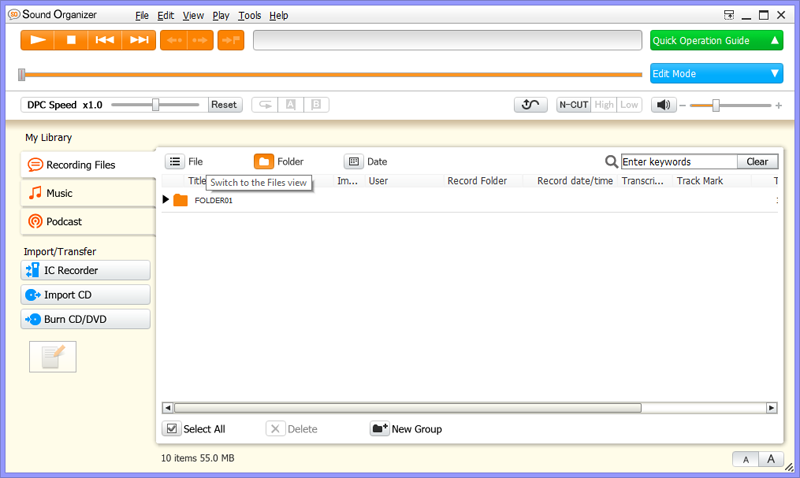
so-1The nice thing is that when there is a new recording on the device, the Sound Organizer, or SO, recognized that immediately and asked if I want to transfer the new files. Right away I did. As a habit I turn off devices before I plug them into the computer. Once it recognizes it, it will turn it on for you.
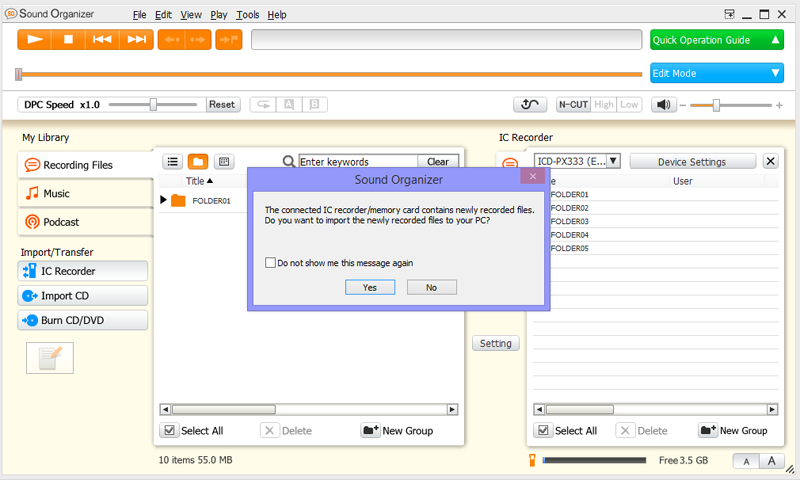
so-2You will notice that when you plug in the recorder, you will get a menu for both the library on your computer and the IC Recorder. You can erase the files on your recorder or transfer back and forth. This is why the SD card is really a moot point. You can transfer recorded files back-and-forth to any device you desire and even burn them to CD or DVD.

With the device plugged in, you can do many things. You can make new folders on your device. By pressing the DEVICE SETTINGS button, you can access all of the menu items instead of fumbling with the MENU button on the device. It also accesses the date and time through your computer and automatically sets it. The PX333 does not display the time and date on the device which is kind of disappointing.

Interestingly, you can also add music and podcast to your device which might be useful if you have a stereo headset. This takes from your recording time, of course. If you are in the habit of waiting around for interviews, though, this might be nice.

The SO software allows you to edit the files so that you can save distinct quotes. You can burn them to a CD or DVD which might be very useful for a radio news host. If you can plug in the device at the station, you can probably even run the quotes off of the device without having to waste a CD or DVD.

One review complained that the device can only record in MP3. I am not sure of the advantage of any other format except, perhaps, that it might extend the recording time. MP3 is a standard and almost all other software recognizes it. I find that makes it easier to add audio from the PX333 into my video editing software.

The one function I was really excited about was the little “notepad” icon all the way to the left and to the bottom. It is highlighted when you have a file selected. That is the transcription icon. I pressed it and hoped that it would transcribe the audio into an editable document. It did not. All it did was set up a page with the information about the file and I had to type in the quotes.
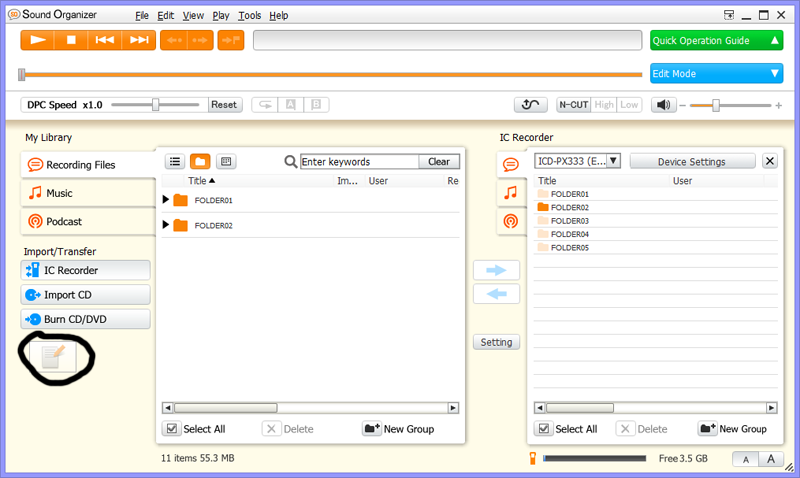
so-3a
Apparently this feature is meant to work with the Dragon NaturallySpeaking program; not provided with this model. I have tried to get it to work with the speech recognition software on Windows 8.1, but with no success. If I figure out how to do it, I will let you know. The SO does provide support for Dragon, so I presume it will work if you have a copy to install.

Another disappointment of this feature is file naming. If you go to transcribe a file, the name of the recorded file is automatically entered as the document file name. This is all right. If you go to create a second file—for whatever purpose—it keeps the recorded file name and does not let you change it. This is a minor inconvenience. You just have to remember to change the file name the first time you transcribe each document.

You can use the DPC Speed to adjust the speed of the speech to match your typing skills.

The other feature I am happy with is the T-MARK button. As you record, you can use this to “flag” certain segments. Say, for example, you are doing an interview. You can press T-MARK before each question and you can then go straight to specific questions that you decide to use in the interview.

Even without the “goodies” provided in the higher-end models, I have to say that I am okay with the purchase, overall. I still have not gone through all of the functionality of the device, so I do not know what I am missing. If I find any really neat stuff, I’ll let you know.



Concerning the Militia review.

PLEASE NOTE: Some of the laws cited in this book HAVE CHANGED since it’s publication. If you explore, you will see why. I will try to update.

I read Glen Davis’ book, Concerning the Militia. This is a subject of which I had already done quite a bit of research on and thought I knew as much as anyone. I had developed some very strong opinions.

While Glen’s work supported most of my opinions, it conflicted with others. But I must say, Glen made his case! I found myself enlightened and with the facts he presented I had no choice but to change my view. Bravo, Glen!

I encourage every American to read this book.

—Paul Arnett, Two Dogs Publishing


Happy Birthday Robert Louis Stevenson

Google

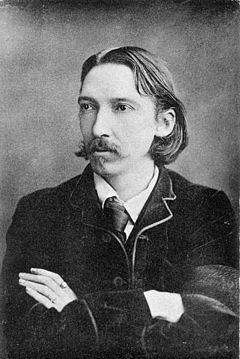
Author Robert Louis Stevenson

Robert Louis Balfour Stevenson (13 November 1850 – 3 December 1894) was a Scottish novelist, poet, essayist and travel writer. His best-known books include Treasure Island, Kidnapped, and The Strange Case of Dr Jekyll and Mr Hyde.

A literary celebrity during his lifetime, Stevenson now ranks among the 30 most translated authors in the world, just below Charles Dickens. He has been greatly admired by many authors, including Jorge Luis Borges, Ernest Hemingway, Rudyard Kipling, Marcel Schwob, Vladimir Nabokov, J. M. Barrie, and G. K. Chesterton, who said of him that he “seemed to pick the right word up on the point of his pen, like a man playing spillikins.”—Wikipedia

Robert Louis Stevenson Biography


Ubuntu 10.01 (Correction .04) may be the replacement you are looking for

™With word circling about the confusion on Windows™ 7 OEM end user license, some may be desiring to go with Windows™ XP. Though you may be allowed another chance at their “downgrade” rights.

There may, however, be another replacement that you hadn’t considered. And it is free.

I recently purchased a new MSI motherboard and had some other computer components laying about.

Ubuntu now has Version 10.04 on their web site available for download. Unless you have a solid connection, I recommend obtaining a copy from one of their outlets. The disks run about $4.99 and most have free shipping.

A Little History

I was impressed with Ubunutu until about version 8. I was able to restore older computers to usefulness, but then Ubuntu started getting too demanding for older machines.

I do not know how 10 will work on older machines. I haven’t tried it. Since I had the dual-core board and was waiting for parts, I decided to test it.

Installing

Ubuntu has narrowed the questions for installing to about six questions. Unlike Windows™, you do not have to have an internet connection, because you do not have to go through the Windows™ permission slip process. However, to upgrade and get the system working to par, you will.

I pieced together a test machine with the parts I had lying around. I tried to install Ubuntu and got an error message. I was frustrated, but I did make two copies of the ISO that I downloaded, so I tried the second. It installed fine.

The first thing that I noticed was the wireless in the top panel. I needed that to connect to the Internet, but it wasn’t connecting. I checked the hardware and it did recognize my cheap RelTek 8185 based wireless card. I was used to the other OS informing me with that annoying little cartoon balloon that there were wireless connections available.

I suddenly realized another advantage of Ubuntu. It does NOT keep giving you annoying balloons telling you that it demands that you do things. Aha! One more advantage to Ubuntu!

I clicked on the wireless icon and got the menu. There I found the wireless connections available. I selected one, entered the code and voila! I was connected.

The second problem that I encountered was the video player included with Ubuntu. It would not play DVDs. It gave me an error message and, after following the links, I found that they cannot include certain packages in the initial install due to legalities. You have to download and install those packages. After doing so, video DVDs played just fine.

Another advantage to Ubuntu is that there are a myriad of software packages that you can install for free. Simply click on Applications and go down to the last item on the menu to install.

There is a Synaptic package install that you get to through the Administration section, but I cannot remember the exact procedure to get to it. I do not have Ububuntu up right now, but you can find it. You can re-install packages and add other programs not available through the other Ubuntu install.

One thing to remember is that you get what you pay for. For support, you may have to dig for hours through support sites to find your answers. If you are good at search engines and can apply just the right keywords, you may find what you need with the first shot.

I recommend trying it by itself and not installing it on your Windows™ machine right away. It takes some getting used to, but once you get the hang of it, you might find it useful to have at least one separate Ubuntu machine available for use.

They do have antivirus software available, but generally Linux machines are attacked less than the other OS. Corporate machines using Linux are attacked, so if you are using it for business, make sure you understand the security before putting it online for your business.

Linux is OpenSource, so there are thousands of developers around the world looking to close any loopholes left open. There are some, but Linux has less open areas than the other OS.

There are hundreds of Linux distros out there besides Ubuntu. Ubuntu is Debian-based and the easiest that I have found to work with when switching from Windows.


Judge Napolitano discusses new book on Alex Jones.

Lies the Government Told You: Myth, Power and Deception in American History
Judge Andrew Napolitano
Forward by Ron Paul

Judge Andrew Napolitano, of Fox Network and radio talk show host, sat on the other side of the mic on Thursday, March 25 to be interviewed by Alex Jones. Late in the interview, he answered a question foremost in the minds of many listeners. In the process of answering a question concerning abuse of power, he said, “Just like Mike Chertoff handed it off to Janet Napolitano—and I know what you’re thinking. The answer is no. We are not related.”

I have not read the book because I have yet to receive my review copy. Of course, I haven’t asked for one. It is currently listed at No. 13 on the New York Times Best Selling List after about a week on the shelves. It follows AMERICAN CONSPIRACIES, by Jesse Ventura with Dick Russell which is currently No. 7 and NO APOLOGY, by Mitt Romney at No. 10.

Judge Napolitano began by explaining his friends reaction to the book. “When I told friends I was writing a book about the government and lies and that it was 4,000 pages long, everybody laughed and said were you able to get all the lies into 4,000 pages,” he said.

About the book: “It shows you the perception that the public has that the government does lie to us, has been lying to us, and we accept these lies and are willing to laugh about it. Even though every one of those lies that I talk about in the book, and those that you mentioned in the introduction destroys our liberty, destroys our freedom by inducing us to make political decisions on erroneous information that the government claims is true. And when we give up this liberty, and loose this property, we don’t get it back.”

In response to Alex’s inquiry about the State of the Union, the Judge replied, “The state of our union is that it is a bipartisan movement toward a police state, and we don’t have two parties in this country, Alex, even though most people think we do. And your listeners know that we have one party—the big government party. There’s a Republican wing that likes war, and deficits and assaults our civil liberties. There’s a Democratic wing that likes welfare, and taxes, and assaults our commercial liberties. But they basically will feed each other because they’re not interested in freedom, they don’t believe in fidelity to the Constitution, they’re just interested in power.”

He described an interview he conducted with James E Clyburn—D, South Carolina Sixth District to illustrate his point. “I mean, on my radio show last month I asked the number three ranking Democrat in the House of representatives—Congressman Jim Clyburn—Congressman, where in the Constitution is the government authorized to regulate health care. And he said to me, Judge, most of what we do down here—referring to Washington—is not authorized by the Constitution. Where in the Constitution is it prohibited that we regulate health care? The very fact that he would ask that question shows a tremendous 180-degree misunderstanding of the federal government.

“The Congress is not a general legislature,” Judge Napolitano continued. “It doesn’t exist in order to right every wrong. It exists only to exercise power in seventeen unique, discreet, specific, well-defined set-out areas in a piece of paper called the Constitution to which he took an oath to uphold. At least he was candid enough to acknowledge they’re not upholding it.”

Alex said that states joining the upcoming suit is not enough and that we need to have states nullify, under the ninth and tenth amendment, not just this but denying them from taking highway and education funds.

“Well, you know it’s one thing, Alex, for a state legislature and a governor to sign a piece of paper saying we stand on our Tenth Amendment and we are a sovereign State. It would be quite another for a state legislature to enact legislation that did the following: Prohibit state employees from enforcing federal law. Indite federal officials who come into the state with intention of enforcing federal law that conflicts with state law. Imposing real estate tax on federal property within the state. Now I know that that has been unlawful for the past two-hundred years, but suffice it to say we have a different Supreme Court, now, that might look at this differently. Drag before county and state grand juries federal officers who insist on enforcing federal law that is unconstitutional within the states. The states really have to stand up for their sovereignty. They have to do more than say we are a sovereign state. There has to be teeth to their proclamation of sovereignty.”

Judge Napolitano suggested a change in the election system. “Now I would like to see the popular election of Senators done away with. I would like to see state legislatures send members of the Senate to the Senate, because then they wouldn’t be stealing power from the states or those Senators would soon be out of their jobs.

The problem that I see is that both means of selecting a Senator—the one that we currently use and the one he suggests—is fraught with inherent corruption. Promises and back room deals could still be made at the State level. Another suggestion of term limits for Senators could, of course, cause the early resignation of a good Senator. I might suggest changing the election cycle of Senators to every two years as we do with the members of the House of Representatives. Further, citizens should be able to recall Senators. Anything we do, however, still requires due diligence by an educated citizenry.

The thing that we have learned, I suppose, is that we should be more willing to fight the government, especially at the school level. We should be teaching the true Constitution, along with reading and math. Instead of indoctrinating, we should be instilling the passion to learn in our students.

“The federal government didn’t begin to grow to gargantuan proportions until the progressive era with the popular election of Senators were able to pander to the collectivist impulses of the masses and deliver as big a piece of pie as they could and create the permanent underclass that relied on them for support and return of their votes,” the Judge explained.

You know when Janet, the head of the Department of Homeland Security, Janet what’s-her-name, announced that the most dangerous people on the planet were the groups you just indicate—right-to-lifers, people who believe in a Second Amendment, returning veterans from the wars, people who think taxes are too high and the government is too onerous—I got in an argument on air with one of my Fox colleagues who said to me well she knows that you are in favor of Second Amendment rights, she knows that you’re pro-life and she knows you’re against the IRS, but how does she know that everybody else feels that way? I said because she can capture—her agents can capture—every keystroke on your computer. How can she do that? he says. Because she has the power under the Patriot act which you—I won’t tell you which Fox colleague this was, but you can probably guess—which you supported when your guy, George W. Bush, was in the White House. Now it’s in the hands of those who would use this power against you. What are you, Crazy? Don’t you realize liberty, once given up, and put in the hands of the government as power never comes back?

“I think the American people should vote out of office, and aggressively hound out of office—lawfully, obviously—not only everyone who voted for Obamacare, but everyone who voted for TARP—proposed by George W. Bush. Everyone who voted for the first two stimuluses that we’ve had in the past four years, which came from George W. Bush. Everyone who voted for the Patriot act, which came from George W. Bush. Everyone who voted for any tax increase. Now that would be about ninety-three to ninety-four percent of the Congress. These people’s voting records must be revealed.

“The collusion of Rand Paul being forced against the guy who’s in charge of counting the ballots. Even Joe Stalin wouldn’t have been so bold as to do that. he would have put a crony in to count the ballots. But in Kentucky, the Republicans are forcing Rand Paul to run against the guy who will decide who wins the election. The American public cannot put up with that.”

Jones asked why the government would want to destroy the economy?

“The government wants to control us because of what Saint Augustan called libido dominandi. Look, we all know about certain types of libido. This is a lust for power. Before the Civil war, we sent people to our State houses and to Congress who were interested in Liberty. Who were concerned with confining the government with assuring that it did not interfere with our natural rights, with our civil liberties, and with our property rights. Since the Civil war, we have sent people to the government—by-and-large. There are exception both before the Civil war and after wards.

“But by-and-large, people who were not interested in liberty, but people who were interested in power. Power for its own sake. Power in and of itself. Power to control other people. Government attracts those with lust for power. Ron Paul and Rand Paul, and Ron Paul’s colleagues in the House and—if there are any in the Senate I’m unaware of them—are the exception to the rule. But for the most part, this is the type of human being that the government attracts.

“And this type of illicit aggregation of power gets worse, and worse and worse, because when they get power, they hand it off to their successors. Just like Mike Chertoff handed it off to Janet Napolitano, and I know what you’re thinking. The answer is no. We are not related. This happens generation after generation after generation. That’s why I’m not optimistic about our future because it will take a generation of Drs. Paul to change this. To stop it. To reverse it.”

Also discussed was the recent move by McCain-Liberman to destroy personal liberties by revisiting the Alien and Sedition acts of 1798. You can find Senator McCain’s statement on the matter here. The Senate Bill proposed is S. 3081 entitled Enemy Belligerent Interrogation, Detention, and Prosecution Act of 2010. The Judge pointed out that under this bill, it would require an act of Congress to release you from U.S. government custody. This interferes with the due process clauses of the Constitution.

In a recent television interview concerning health care legislation, purported to understand what the founding fathers envisioned. About the lawsuits he said they are going, “…pretty well. You notice that State Legislatures and Attorneys General and Governors all over America are challenging the Constitutionality. I think they have very legitimate Constitutional challenge. The government’s now going to force individuals to buy health care insurance at the level they want them to have it, and if they don’t they are going to fine them. I’m not sure that is what the founding father’s that had in mind.”

It’s amazing that Senator McCain cannot see the Fourth, Fifth, Ninth and Tenth Amendments in the same light. He does not seem to understand the separation of powers inherent in the words of the Constitution. He apparently is unfamiliar with Article III of the Constitution. It is amazing how people invoke the image of the brown parchment when it suits their needs.

Judge Napolitano explained a bit of Constitutional History. “Do you remember, Alex, studying basic American History? The King of England had ingenious ways to tax us. The last straw was the Stamp act. It required that every colonists have on every piece of paper in his or her home a stamp. Every book, every bank draft, every mortgage, every lease, every deed, every pamphlet, even a poster that was going to be nailed to a tree had to have the King’s stamp on it. Imagine having to go—we have enough difficulties with the Post Office, as it is—you had to go to a foreign post office in the colonies and buy the King’s stamp.

“Question. How did the government know if you had the King’s stamp on every piece of paper in your house? Answer: The Parliament enacted the Townsend acts which permitted British soldiers to write their own search warrants. And thus they would show up at your home and hand you a piece of paper on which they had purported to authorized themselves to enter your home ostensibly to look for the stamps. Of course they would confiscate alcohol. They would confiscate furniture which you couldn’t demonstrate you had paid taxes on. They would even sometimes kick you out of the house and take it over for days, or weeks, or months.

“We fought a revolution. We won the Revolution. We wrote a Constitution. We added the Fourth Amendment to that Constitution. Which, next to the right-to-life, is the greatest right there is; the right to be left alone. And it says the government can’t come onto your property and can’t seize what you have and can’t intrude into your privacy unless it goes to a judge and demonstrates to a neutral judge that its more likely than not that you are committing a crime.”

“Fast forward two-hundred years to the Patriot act. What does the Patriot act do? It allows federal agents to write their own search warrants. We have elected a government that has done the very same thing to us, which was the last straw when we broke away from an island three-thousand miles away that was regulating us as if we were chattel and as if we were slaves to them.”