What Makes a Radio Valuable?

©2000 by Glen C. Davis

PLEASE NOTE: This is an opinion piece. You are free to agree or disagree with it. It is only here to give you an idea of how to value your radio.

For those of you that watch programs setting antique prices and want to trust PBS with the value of your radio, this article is not for you. I will also emphatically state that I am not an expert. Working with Grand Canyon Tube Radio, though, I have had to do a lot of research. I’m still doing much more. The thing I have found about any collectible, however, is that it’s value depends on what people will pay for it. No more, no less. If you are talking about something that has been passed down from generation to generation in your family, the sentimental nature of it cannot be valued.

What is the value of my radio?

I don’t know. There are many factors to consider. If you are considering buying a radio to resale for ten times more, my recommendation would be to consider buying coins or baseball cards. You might buy a radio for ten dollars, get it working and find someone to buy it for a thousand. Or you might find someone who will give you ten dollars.

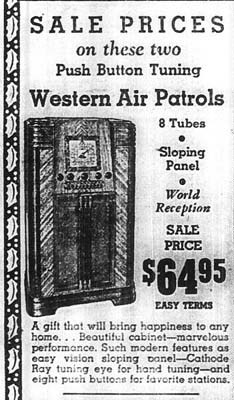
Fig. 1. Western Auto Air Patrol Model.


Let’s say you purchase the Western Auto “Air Patrol” model pictured in Figure 1. You restore it, get it working great and decide to put it on the open market. You can see that it’s original selling price was $64.95. You decide the value of your restoration is worth ten times that much, so you set the price at $649.50. Well, let’s round it up to $650. You might come across someone who wants it to set in their foyer as a conversation piece who might offer $200. Then again, you might find someone who just can’t live without every model of the “Air Patrol,” and you have the one model he hasn’t been able to find. You might get $700 out of him.

The bottom line is the value is in the eye of the beholder. I, for example, like short wave. I want a console with broadcast (AM) and short wave and I want the little “police” label on it like the old RCA 94BT1. If you’ve got what I want, I have to pay your price. Except, of course, I can’t afford $650.

Another consideration is as a family heir loom. Let’s say your father who passed it to you kept it in the attic where the mice could get to it. You want to pass it to your children, but look at the condition. The wires are eaten through, two of the tubes are broken, the finish is peeling off and so on. You have to consider what you want your children to have. If you’re into electronics, you can dive in and try to fix it yourself. Or you can get a qualified service technician.

Prices you find on web sites generally include the cost of acquiring the radio, parts and labor to get it restored, and a mark-up. Remember, web sites are generally businesses. They do not necessarily reflect the “value” of the radio.

What is a qualified service technician?

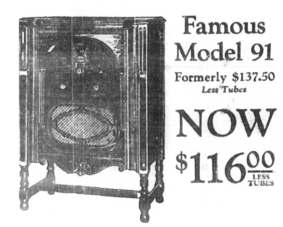
Famous Majestic Model 91

That is a good and relatively tough question to answer. There are no certificates or bronze plaques from companies saying that this technician or that can fix this particular brand of radio. They used to certify them and they do today for their modern equipment.

One step is to look to your local antique dealer. They may work with someone who repairs old radios. Of course, there’s the Internet. You can check http://www.grandcanyontuberadio.com, for a start.

You might know someone who restored their old radio. Try them. They might do it out of love of the radio for the cost of parts. Of course, they might charge you an hourly rate, as well. If you find the former, try him!

What should I have done to it?

If you listen to those shows where they tell you that re-finishing a radio decreases its value, then don’t have it done. The deterioration will continue until the legs start falling off of the console and you can see if someone will buy it from you. If you do decide to get it re-finished, it will most assuredly last longer, be a beautiful addition to your decor and be a great conversation piece.


What about replacing old capacitors and resistors with new? Will that decrease the value? Well, you might consider that very few people will walk into your house and say, “Well, that’s a nice radio. Let’s just pull it out and look in the back. Uh-oh!” Most people will come in and comment on how nice it looks or how good it sounds. Some old capacitors are even dangerous. Some contain PCBs which can cause health problems. Certain tubes are no longer available, but have solid state equivalents. While most technicians will not replace components unless absolutely necessary, on some instances, the “contamination” cannot be avoided.

If you turn it on and hear the rich, mellow sound of the tubes (which does sound much better than solid state today), then sit back, grab a book and enjoy.

EXTERNAL LINKS:

1. Radio Value Guide
2. Some good articles by antiqueradio.org


The Atom and Biological Science


2011 Patriot Journal now available.

The 2011 Patriot Journal is now available. It contains much of the same information as the Patriotic Observances Handbook, but includes a monthly calendar, two pages for appointments and journal pages for your thoughts. Few graphics to leave room for your notes.

$12.95

PREVIEW


Patriotic Observance Handbook

The Patriotic Observance Handbook and Patriot Calendar is being made available, though it is still in its formative stages. I went through a search of Title 31 of the U.S. Code, on a search for information on National Prayer Day and was amazed at how many holidays I did not know about. For example, Honor America Days and Gold Star Mothers Day.

I added significant dates concerning American History and the development of our American culture. Yes, Virginia, there is an American culture.

As I watched old tapes of the American War of Independence aired on the History channel years ago, they point out that—even under King George III—the colonies were the freest in the world.

Just finished adding a table with all of the States, dates they were admitted to the union, capitol cities and mottoes.

The work will continue as I have dates to add and some things, but I am hoping that it will help people find the time to study what made this country great—and why we should return to it.


100 Years Later, Mark Twain’s Autobiography Set to Be Published

The first volume of Twain’s 5,000-page manuscript, which has been sitting inside a vault at the University of California, Berkeley, will hit the press in November 2010, the Independent reported Monday.

Mark Twain’s (Samuel Langhorne Clemens—November 30, 1835 – April 21, 1910) dying wish has finally been granted: His lengthy autobiography is set to be published on the 100th anniversary of his death.

The first volume of Twain’s 5,000-page manuscript, which has been sitting inside a vault at the University of California, Berkeley, will hit the press in November 2010, the Independent reported Monday.

The creator of Tom Sawyer and Huckleberry Finn left hand-written notes at the time of his death in 1910, saying he did not want the memoirs to be published for at least a century.

There are several theories as to why Twain wanted publication of his memoirs delayed. Some scholars say the author wanted to speak freely about religion and politics, while others believe Twain wanted to avoid offending friends, the paper reported.

The Independent


A View of the Constitution of the United States

Just Added!

A View of the Constitution of the United States of America was written by Williams Rawle, LL.D. in 1829. The Senate writes of Rawle in Senate Document 2807; A report on the Second Amendment by the Senate Judiciary Committee during the 97rd Congress in February of 1982. Senator Orin Hatch wrote of Rawle,

The Jefferson papers in the Library of Congress show that both [St. George] Tucker and Rawle were friends of, and corresponded with, Thomas Jefferson. Their views are those of contemporaries of Jefferson, Madison and others, and are entitled to special weight.

Senator Hatch quoted A View of the Constitution of the United States of America concerning the Second Amendment. Concerning that amendment, Rawle writes

No clause in the Constitution could by a rule of construction be conceived to give to Congress a power to disarm the people. Such a flagitious attempt could only be made under some general pretense by a state legislature. But if in blind pursuit of inordinate power, either should attempt it, this amendment may be appealed to as a restraint on both

I find some inconsistencies in the logic Rawle uses concerning the decision written by Chief Justice Marshall concerning the Interstate Commerce Clause of the Constitution. On the one hand, he notes that it cannot be used to disarm the people; or, in other words, violate the inalienable Second Amendment. On the other, he seems to approve of the Marshall definition as he writes:

These principles are so fully and clearly explained by Chief Justice Marshall in a recent case, that we shall make no apology for inserting a large extract from his opinion.
“Commerce, as the word is used in the Constitution, is a unit, every part of which is indicated by the term.
“If this be the admitted meaning of the word, in its application to foreign nations, it must carry the same meaning throughout the sentence, and remain a unit, unless there be some plain, intelligible cause which alters it.
“The subject to which the power is next applied is to commerce ‘among the several states.’ Commerce among the states cannot stop at the external boundary line of each state, but may be introduced into the interior.
“These words do not, however, comprehend that commerce which is completely internal, which is carried on between man and man in a state, or between different parts of the same state, and which does not extend to, or affect other states.
“Comprehensive as the word ‘among’ is, it may very properly be restricted to that commerce which concerns more states than one. The phrase would probably not have been selected to indicate the completely interior traffic of a state, because it is not an apt phrase for that purpose; and the enumeration of the particular classes of commerce to which the power was to be extended, would not have been made had the intention been to extend the power to every description. The enumeration presupposes something not enumerated; and that something, if we regard the language or the subject of the sentence, must be the exclusively internal commerce of a state. The genius and character of the whole government seem to be, that its action is to be applied to all the external commercial concerns of the nation, and to those internal concerns which affect the states generally; but not to those which are completely within a particular state, which do not affect other states, and with which it is not necessary to interfere for the purpose of executing some of the general powers of the government. The completely internal commerce of a state may be considered as reserved for the state itself.
“But in regulating commerce with foreign nations the power of congress does not stop at the jurisdictional lines of the several states. It would be a very useless power if it did. The commerce of the United States with foreign nations is that of the whole United States. Every district has a right to participate in it. If congress has the power to regulate it, that power must be exercised wherever the subject exists. If it exists within the states, if a foreign voyage may commence or terminate at a port within a state, then the power of congress may be exercised within a state.
“This principle is, if possible, still more clear when applied to commerce ‘among the several states.’ They either join each other, in which case they are separated by a mathematical line; or they are remote from each other, in which case other states lie between them. What is commerce ‘among’ them, and how is it to be conducted? Can a trading expedition between two adjoining states commence and terminate outside of each? And if the trading intercourse be between two states remote from each other, must it not commence in one, terminate in the other, and probably pass through a third? Commerce among the states must, of necessity, be commerce within the states. In the regulation of trade with the Indian tribes, the action of the law, especially when the Constitution was made, was chiefly within a state. The power of congress, then, may be exercised within the territorial jurisdiction of the several states.”

I confess that I have not read the entire work, as yet, so I may be missing something. You will notice, however, that in the recent health care legislation that the Congress now permits health insurance companies to do business across state lines. There is a reason for this. They could not regulate health care and health care insurance if the companies could not conduct interstate commerce. This is a clear act of subversives desiring total government control of the health care industry. It clearly violates the Ninth Amendment to the Constitution of the United States when it demands that you purchase health insurance or be fined. Equally unconstitutional is the requirement for automotive insurance, though one can see that as a more reasonable requirement. You are, after all, responsible for the lives of others when you are on the road.

Government control of any industry was not outlined by the Constitution nor by our capitalistic traditions. The Interstate Commerce Clause was never intended to allow government to control any industry or person directly. And it was never intended as a doorway to repeal the inalienable Bill of Rights.

Rawle covers topics concerning all areas of the Constitution. He covers the enumerated powers of the government and their limitations. He describes why treaties that violate the Constitution or State laws are unconstitutional. In other words, you are allowed to arrest someone who had “diplomatic immunity” for smuggling drugs, reckless driving or raping your daughters. A treaty which limits your right to purchase a certain firearm because another country cannot control its internal affairs is unconstitutional and does not have to be treated as law within a state.

Some of the titles of the chapters are nearly as long as the chapter itself, but covers the topics as necessary. Remember that this man wrote to, and spoke with, the founders on topics of the Constitution and, in turn, shared his knowledge with us. It is well worth reading whether you buy a copy from us for $10.00, or get a free version from Project Gutenberg. There is, also, a version available for download.


Veterans Run for the Wall

What it's all about

WILLIAMS—(May 20) Vietnam, and other veterans, left Williams this morning on their ten-day journey in remembrance of the veterans whose names appear on the Vietnam Memorial wall in Washington D.C. Their motto, “We ride for those who cannot.” Their first stop every year is the northern Arizona City of Williams.

The Run for the Wall event occurs every year about this time and their first stop is in Williams. The riders came into Williams last night and were treated to a meal at the Cordova Post #14 American Legion hall.

Constitutional Republic Party


Judge Napolitano discusses new book on Alex Jones.

Lies the Government Told You: Myth, Power and Deception in American History
Judge Andrew Napolitano
Forward by Ron Paul

Judge Andrew Napolitano, of Fox Network and radio talk show host, sat on the other side of the mic on Thursday, March 25 to be interviewed by Alex Jones. Late in the interview, he answered a question foremost in the minds of many listeners. In the process of answering a question concerning abuse of power, he said, “Just like Mike Chertoff handed it off to Janet Napolitano—and I know what you’re thinking. The answer is no. We are not related.”

I have not read the book because I have yet to receive my review copy. Of course, I haven’t asked for one. It is currently listed at No. 13 on the New York Times Best Selling List after about a week on the shelves. It follows AMERICAN CONSPIRACIES, by Jesse Ventura with Dick Russell which is currently No. 7 and NO APOLOGY, by Mitt Romney at No. 10.

Judge Napolitano began by explaining his friends reaction to the book. “When I told friends I was writing a book about the government and lies and that it was 4,000 pages long, everybody laughed and said were you able to get all the lies into 4,000 pages,” he said.

About the book: “It shows you the perception that the public has that the government does lie to us, has been lying to us, and we accept these lies and are willing to laugh about it. Even though every one of those lies that I talk about in the book, and those that you mentioned in the introduction destroys our liberty, destroys our freedom by inducing us to make political decisions on erroneous information that the government claims is true. And when we give up this liberty, and loose this property, we don’t get it back.”

In response to Alex’s inquiry about the State of the Union, the Judge replied, “The state of our union is that it is a bipartisan movement toward a police state, and we don’t have two parties in this country, Alex, even though most people think we do. And your listeners know that we have one party—the big government party. There’s a Republican wing that likes war, and deficits and assaults our civil liberties. There’s a Democratic wing that likes welfare, and taxes, and assaults our commercial liberties. But they basically will feed each other because they’re not interested in freedom, they don’t believe in fidelity to the Constitution, they’re just interested in power.”

He described an interview he conducted with James E Clyburn—D, South Carolina Sixth District to illustrate his point. “I mean, on my radio show last month I asked the number three ranking Democrat in the House of representatives—Congressman Jim Clyburn—Congressman, where in the Constitution is the government authorized to regulate health care. And he said to me, Judge, most of what we do down here—referring to Washington—is not authorized by the Constitution. Where in the Constitution is it prohibited that we regulate health care? The very fact that he would ask that question shows a tremendous 180-degree misunderstanding of the federal government.

“The Congress is not a general legislature,” Judge Napolitano continued. “It doesn’t exist in order to right every wrong. It exists only to exercise power in seventeen unique, discreet, specific, well-defined set-out areas in a piece of paper called the Constitution to which he took an oath to uphold. At least he was candid enough to acknowledge they’re not upholding it.”

Alex said that states joining the upcoming suit is not enough and that we need to have states nullify, under the ninth and tenth amendment, not just this but denying them from taking highway and education funds.

“Well, you know it’s one thing, Alex, for a state legislature and a governor to sign a piece of paper saying we stand on our Tenth Amendment and we are a sovereign State. It would be quite another for a state legislature to enact legislation that did the following: Prohibit state employees from enforcing federal law. Indite federal officials who come into the state with intention of enforcing federal law that conflicts with state law. Imposing real estate tax on federal property within the state. Now I know that that has been unlawful for the past two-hundred years, but suffice it to say we have a different Supreme Court, now, that might look at this differently. Drag before county and state grand juries federal officers who insist on enforcing federal law that is unconstitutional within the states. The states really have to stand up for their sovereignty. They have to do more than say we are a sovereign state. There has to be teeth to their proclamation of sovereignty.”

Judge Napolitano suggested a change in the election system. “Now I would like to see the popular election of Senators done away with. I would like to see state legislatures send members of the Senate to the Senate, because then they wouldn’t be stealing power from the states or those Senators would soon be out of their jobs.

The problem that I see is that both means of selecting a Senator—the one that we currently use and the one he suggests—is fraught with inherent corruption. Promises and back room deals could still be made at the State level. Another suggestion of term limits for Senators could, of course, cause the early resignation of a good Senator. I might suggest changing the election cycle of Senators to every two years as we do with the members of the House of Representatives. Further, citizens should be able to recall Senators. Anything we do, however, still requires due diligence by an educated citizenry.

The thing that we have learned, I suppose, is that we should be more willing to fight the government, especially at the school level. We should be teaching the true Constitution, along with reading and math. Instead of indoctrinating, we should be instilling the passion to learn in our students.

“The federal government didn’t begin to grow to gargantuan proportions until the progressive era with the popular election of Senators were able to pander to the collectivist impulses of the masses and deliver as big a piece of pie as they could and create the permanent underclass that relied on them for support and return of their votes,” the Judge explained.

You know when Janet, the head of the Department of Homeland Security, Janet what’s-her-name, announced that the most dangerous people on the planet were the groups you just indicate—right-to-lifers, people who believe in a Second Amendment, returning veterans from the wars, people who think taxes are too high and the government is too onerous—I got in an argument on air with one of my Fox colleagues who said to me well she knows that you are in favor of Second Amendment rights, she knows that you’re pro-life and she knows you’re against the IRS, but how does she know that everybody else feels that way? I said because she can capture—her agents can capture—every keystroke on your computer. How can she do that? he says. Because she has the power under the Patriot act which you—I won’t tell you which Fox colleague this was, but you can probably guess—which you supported when your guy, George W. Bush, was in the White House. Now it’s in the hands of those who would use this power against you. What are you, Crazy? Don’t you realize liberty, once given up, and put in the hands of the government as power never comes back?

“I think the American people should vote out of office, and aggressively hound out of office—lawfully, obviously—not only everyone who voted for Obamacare, but everyone who voted for TARP—proposed by George W. Bush. Everyone who voted for the first two stimuluses that we’ve had in the past four years, which came from George W. Bush. Everyone who voted for the Patriot act, which came from George W. Bush. Everyone who voted for any tax increase. Now that would be about ninety-three to ninety-four percent of the Congress. These people’s voting records must be revealed.

“The collusion of Rand Paul being forced against the guy who’s in charge of counting the ballots. Even Joe Stalin wouldn’t have been so bold as to do that. he would have put a crony in to count the ballots. But in Kentucky, the Republicans are forcing Rand Paul to run against the guy who will decide who wins the election. The American public cannot put up with that.”

Jones asked why the government would want to destroy the economy?

“The government wants to control us because of what Saint Augustan called libido dominandi. Look, we all know about certain types of libido. This is a lust for power. Before the Civil war, we sent people to our State houses and to Congress who were interested in Liberty. Who were concerned with confining the government with assuring that it did not interfere with our natural rights, with our civil liberties, and with our property rights. Since the Civil war, we have sent people to the government—by-and-large. There are exception both before the Civil war and after wards.

“But by-and-large, people who were not interested in liberty, but people who were interested in power. Power for its own sake. Power in and of itself. Power to control other people. Government attracts those with lust for power. Ron Paul and Rand Paul, and Ron Paul’s colleagues in the House and—if there are any in the Senate I’m unaware of them—are the exception to the rule. But for the most part, this is the type of human being that the government attracts.

“And this type of illicit aggregation of power gets worse, and worse and worse, because when they get power, they hand it off to their successors. Just like Mike Chertoff handed it off to Janet Napolitano, and I know what you’re thinking. The answer is no. We are not related. This happens generation after generation after generation. That’s why I’m not optimistic about our future because it will take a generation of Drs. Paul to change this. To stop it. To reverse it.”

Also discussed was the recent move by McCain-Liberman to destroy personal liberties by revisiting the Alien and Sedition acts of 1798. You can find Senator McCain’s statement on the matter here. The Senate Bill proposed is S. 3081 entitled Enemy Belligerent Interrogation, Detention, and Prosecution Act of 2010. The Judge pointed out that under this bill, it would require an act of Congress to release you from U.S. government custody. This interferes with the due process clauses of the Constitution.

In a recent television interview concerning health care legislation, purported to understand what the founding fathers envisioned. About the lawsuits he said they are going, “…pretty well. You notice that State Legislatures and Attorneys General and Governors all over America are challenging the Constitutionality. I think they have very legitimate Constitutional challenge. The government’s now going to force individuals to buy health care insurance at the level they want them to have it, and if they don’t they are going to fine them. I’m not sure that is what the founding father’s that had in mind.”

It’s amazing that Senator McCain cannot see the Fourth, Fifth, Ninth and Tenth Amendments in the same light. He does not seem to understand the separation of powers inherent in the words of the Constitution. He apparently is unfamiliar with Article III of the Constitution. It is amazing how people invoke the image of the brown parchment when it suits their needs.

Judge Napolitano explained a bit of Constitutional History. “Do you remember, Alex, studying basic American History? The King of England had ingenious ways to tax us. The last straw was the Stamp act. It required that every colonists have on every piece of paper in his or her home a stamp. Every book, every bank draft, every mortgage, every lease, every deed, every pamphlet, even a poster that was going to be nailed to a tree had to have the King’s stamp on it. Imagine having to go—we have enough difficulties with the Post Office, as it is—you had to go to a foreign post office in the colonies and buy the King’s stamp.

“Question. How did the government know if you had the King’s stamp on every piece of paper in your house? Answer: The Parliament enacted the Townsend acts which permitted British soldiers to write their own search warrants. And thus they would show up at your home and hand you a piece of paper on which they had purported to authorized themselves to enter your home ostensibly to look for the stamps. Of course they would confiscate alcohol. They would confiscate furniture which you couldn’t demonstrate you had paid taxes on. They would even sometimes kick you out of the house and take it over for days, or weeks, or months.

“We fought a revolution. We won the Revolution. We wrote a Constitution. We added the Fourth Amendment to that Constitution. Which, next to the right-to-life, is the greatest right there is; the right to be left alone. And it says the government can’t come onto your property and can’t seize what you have and can’t intrude into your privacy unless it goes to a judge and demonstrates to a neutral judge that its more likely than not that you are committing a crime.”

“Fast forward two-hundred years to the Patriot act. What does the Patriot act do? It allows federal agents to write their own search warrants. We have elected a government that has done the very same thing to us, which was the last straw when we broke away from an island three-thousand miles away that was regulating us as if we were chattel and as if we were slaves to them.”