100 Years Later, Mark Twain’s Autobiography Set to Be Published

The first volume of Twain’s 5,000-page manuscript, which has been sitting inside a vault at the University of California, Berkeley, will hit the press in November 2010, the Independent reported Monday.

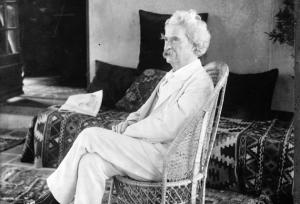
Mark Twain’s (Samuel Langhorne Clemens—November 30, 1835 – April 21, 1910) dying wish has finally been granted: His lengthy autobiography is set to be published on the 100th anniversary of his death.

The first volume of Twain’s 5,000-page manuscript, which has been sitting inside a vault at the University of California, Berkeley, will hit the press in November 2010, the Independent reported Monday.

The creator of Tom Sawyer and Huckleberry Finn left hand-written notes at the time of his death in 1910, saying he did not want the memoirs to be published for at least a century.

There are several theories as to why Twain wanted publication of his memoirs delayed. Some scholars say the author wanted to speak freely about religion and politics, while others believe Twain wanted to avoid offending friends, the paper reported.

The Independent


A View of the Constitution of the United States

Just Added!

A View of the Constitution of the United States of America was written by Williams Rawle, LL.D. in 1829. The Senate writes of Rawle in Senate Document 2807; A report on the Second Amendment by the Senate Judiciary Committee during the 97rd Congress in February of 1982. Senator Orin Hatch wrote of Rawle,

The Jefferson papers in the Library of Congress show that both [St. George] Tucker and Rawle were friends of, and corresponded with, Thomas Jefferson. Their views are those of contemporaries of Jefferson, Madison and others, and are entitled to special weight.

Senator Hatch quoted A View of the Constitution of the United States of America concerning the Second Amendment. Concerning that amendment, Rawle writes

No clause in the Constitution could by a rule of construction be conceived to give to Congress a power to disarm the people. Such a flagitious attempt could only be made under some general pretense by a state legislature. But if in blind pursuit of inordinate power, either should attempt it, this amendment may be appealed to as a restraint on both

I find some inconsistencies in the logic Rawle uses concerning the decision written by Chief Justice Marshall concerning the Interstate Commerce Clause of the Constitution. On the one hand, he notes that it cannot be used to disarm the people; or, in other words, violate the inalienable Second Amendment. On the other, he seems to approve of the Marshall definition as he writes:

These principles are so fully and clearly explained by Chief Justice Marshall in a recent case, that we shall make no apology for inserting a large extract from his opinion.
“Commerce, as the word is used in the Constitution, is a unit, every part of which is indicated by the term.
“If this be the admitted meaning of the word, in its application to foreign nations, it must carry the same meaning throughout the sentence, and remain a unit, unless there be some plain, intelligible cause which alters it.
“The subject to which the power is next applied is to commerce ‘among the several states.’ Commerce among the states cannot stop at the external boundary line of each state, but may be introduced into the interior.
“These words do not, however, comprehend that commerce which is completely internal, which is carried on between man and man in a state, or between different parts of the same state, and which does not extend to, or affect other states.
“Comprehensive as the word ‘among’ is, it may very properly be restricted to that commerce which concerns more states than one. The phrase would probably not have been selected to indicate the completely interior traffic of a state, because it is not an apt phrase for that purpose; and the enumeration of the particular classes of commerce to which the power was to be extended, would not have been made had the intention been to extend the power to every description. The enumeration presupposes something not enumerated; and that something, if we regard the language or the subject of the sentence, must be the exclusively internal commerce of a state. The genius and character of the whole government seem to be, that its action is to be applied to all the external commercial concerns of the nation, and to those internal concerns which affect the states generally; but not to those which are completely within a particular state, which do not affect other states, and with which it is not necessary to interfere for the purpose of executing some of the general powers of the government. The completely internal commerce of a state may be considered as reserved for the state itself.
“But in regulating commerce with foreign nations the power of congress does not stop at the jurisdictional lines of the several states. It would be a very useless power if it did. The commerce of the United States with foreign nations is that of the whole United States. Every district has a right to participate in it. If congress has the power to regulate it, that power must be exercised wherever the subject exists. If it exists within the states, if a foreign voyage may commence or terminate at a port within a state, then the power of congress may be exercised within a state.
“This principle is, if possible, still more clear when applied to commerce ‘among the several states.’ They either join each other, in which case they are separated by a mathematical line; or they are remote from each other, in which case other states lie between them. What is commerce ‘among’ them, and how is it to be conducted? Can a trading expedition between two adjoining states commence and terminate outside of each? And if the trading intercourse be between two states remote from each other, must it not commence in one, terminate in the other, and probably pass through a third? Commerce among the states must, of necessity, be commerce within the states. In the regulation of trade with the Indian tribes, the action of the law, especially when the Constitution was made, was chiefly within a state. The power of congress, then, may be exercised within the territorial jurisdiction of the several states.”

I confess that I have not read the entire work, as yet, so I may be missing something. You will notice, however, that in the recent health care legislation that the Congress now permits health insurance companies to do business across state lines. There is a reason for this. They could not regulate health care and health care insurance if the companies could not conduct interstate commerce. This is a clear act of subversives desiring total government control of the health care industry. It clearly violates the Ninth Amendment to the Constitution of the United States when it demands that you purchase health insurance or be fined. Equally unconstitutional is the requirement for automotive insurance, though one can see that as a more reasonable requirement. You are, after all, responsible for the lives of others when you are on the road.

Government control of any industry was not outlined by the Constitution nor by our capitalistic traditions. The Interstate Commerce Clause was never intended to allow government to control any industry or person directly. And it was never intended as a doorway to repeal the inalienable Bill of Rights.

Rawle covers topics concerning all areas of the Constitution. He covers the enumerated powers of the government and their limitations. He describes why treaties that violate the Constitution or State laws are unconstitutional. In other words, you are allowed to arrest someone who had “diplomatic immunity” for smuggling drugs, reckless driving or raping your daughters. A treaty which limits your right to purchase a certain firearm because another country cannot control its internal affairs is unconstitutional and does not have to be treated as law within a state.

Some of the titles of the chapters are nearly as long as the chapter itself, but covers the topics as necessary. Remember that this man wrote to, and spoke with, the founders on topics of the Constitution and, in turn, shared his knowledge with us. It is well worth reading whether you buy a copy from us for $10.00, or get a free version from Project Gutenberg. There is, also, a version available for download.


Veterans Run for the Wall

What it's all about

WILLIAMS—(May 20) Vietnam, and other veterans, left Williams this morning on their ten-day journey in remembrance of the veterans whose names appear on the Vietnam Memorial wall in Washington D.C. Their motto, “We ride for those who cannot.” Their first stop every year is the northern Arizona City of Williams.

The Run for the Wall event occurs every year about this time and their first stop is in Williams. The riders came into Williams last night and were treated to a meal at the Cordova Post #14 American Legion hall.

Constitutional Republic Party


The Government Class Book is now available.

Now available!

The Government Class Book, by Andrew Young (1865) is now available for purchase for $12.00 in 8 x 11 paperback. The download is $4.00.

The book is formatted tightly to reduce the number of pages. That is, there is very little margin space for notes. Later editions might add one or two pages for notes depending on the index. Speaking of the index, I added a quick one. I plan to revise it in later editions.

I have not read the entire work yet. However, it appears to go into much more detail concerning citizenship than just the Constitution. It covers many legal terms used and from where they are derived.

As a sample, the first section is entitled Principles of Government. In Chapter Two of that section, Rights and Liberty, defined, we read:

Sec.3. The rights here mentioned are natural rights. They are so called because they are ours by nature or by birth; and they can not be justly taken from us or alienated. Hence they are also called inalienable. We may, however, forfeit them by some offense or crime. If, for example, a man is fined for breaking a law, he loses his right to the money he is obliged to pay. By stealing, he forfeits his liberty, and may be justly imprisoned. By committing murder, he forfeits his right to life, and may be hanged.

You won’t find that in text books at NAU today.

Under the topic of Laws, defined we find:

Sec.7. If, as has been said, the laws of the Creator form a perfect rule of conduct for all mankind, and ought in all cases to be obeyed, then all human law ought to agree with the divine law. If a human law is contrary to the divine law, or if it requires us to disobey the commands of God, it is not binding, and should not be obeyed. So the Scriptures teach. They speak approvingly of men who disobeyed human authority, and who gave as the reason, that it was their duty to obey God rather than men; and they furnish many examples of good men who submitted to severe punishment, even to death, rather than do what they knew to be contrary to the divine will.

Sec.8. But although the divine will as revealed in the Scriptures, is a perfect rule or law for all mankind, and although human laws ought to conform to the divine law, yet it would be impossible to govern the people of a state by that law alone. The divine law is broad, and comprehends rules to teach men their whole duty; but it does not specify every particular act of duty. Much of it consists of general principles to which particular acts must be made to conform. It requires men to deal justly with each other; but men do not always agree as to what is right. Human laws, therefore, become necessary to declare what shall be considered just and right between man and man.

The manual has the distinct advantage of having been written closer to the signing of the Constitution so there was less time to twist the concepts on which the Constitution was founded. The section quoted above describes that our laws are based on the Holy Scripture. It does not dwell on that, however. It simply goes on to describe the rules and definitions of citizenship in a clear language understandable today.

I, also, note that the information is freely available on the Internet. I do not make a “killing” on any classic reprints in my catalog. Only enough to, hopefully, get paid a little for my efforts.

I am waiting, now, on the hard copy of A View of the Constitution of the United States by William Rawle. This is another excellent work on the Constitution written before Harvard turned to the New World Order.


The Government Class Book

I am currently working on adding another political science reprint on the Constitution. The Government Class Book was written by Andrew W Young, the author of Science of Government, First Lessons in Civil Government, American Statesman and Citizen’s Manual of Government and Law. It was originally published in 1865 and not only covers the Constitution, but gives brief descriptions of several law concepts.

The book has the advantage of being published closer to the date of the adoption of the Constitution. Thus, it is probably closer in explaining what the founding fathers desired than the “civics” books of today.

The book is in reprint through other sources and can be found free in several places including Project Gutenberg. I am in the process of formatting and editing and I hope to have it published by the end of the week at Lulu.com.

So why am I adding a book that you can get for free or from other sources? The intent of this article is to make you aware that it exist. As for why I am reprinting it, I am doing so for my sake. To have a hard copy that I can read and annotate. The same reason that I publish many classic books.

Preface.

The utility of the diffusion of political knowledge among a people exercising the right of self-government, is universally admitted. The form of government established by the people of the United States, though well adapted to promote the general welfare, is highly complicated; and the knowledge requisite to administer it successfully can not be acquired without much study. From the fact that a large portion of the American people are greatly deficient in this knowledge, we may justly conclude that it will never become general, until it shall have been made an object of school instruction.
The administration of the government of this great and rapidly increasing republic, will, in a few years, devolve upon those who are now receiving instruction in the public schools. Yet thousands annually complete their school education, who have never devoted any time to the study of the principles of the government in which they are soon to take a part—who become invested with political power without the preparation necessary to exercise it with discretion. The schools are regarded as the nurseries of our future statesmen. They share largely in the bounty of the state; yet few of them render in return even the rudiments of political science to those who are to become her legislators, and governors, and judges. Not only in the common schools generally, but in a large portion of the high schools and seminaries, this science is not included in the course of instruction.
To many of the most enlightened friends of education and of our free institutions, it has long been a matter of surprise as well as regret, that those to whom the educational interests of the states are more immediately intrusted, should so long have treated the study in question as of minor importance, or have suffered it to be excluded by studies of far less practical utility. The Regents of the University of the State of New York have repeatedly noticed the neglect of this study in the academies and seminaries subject to their visitation; and they mention it as a remarkable fact, that in many of them preference is given to the study of the Grecian and Roman antiquities. They say: “The constitutions, laws, manners, and customs of ancient Greece and Rome are made subjects of regular study, quarter after quarter, while our own constitutional jurisprudence, and the every day occurring principles of our civil jurisprudence, are not admitted as a part of the academic course!”
To persons who are to engage in any of the industrial or professional pursuits, a preparatory course of training or discipline is deemed indispensable to success. Yet many assume the weighty responsibilities of freemen, and allow their sons to do the same, with scarcely any knowledge of a freeman’s duties. On the intelligent exercise of political power, the public prosperity and the security of our liberties mainly depend. Every person, therefore, who is entitled to the rights of a citizen, is justly held responsible for the proper performance of his political duties. And any course of popular instruction which fails to impart a knowledge of our system of government, must be materially defective.
With a view to supply this deficiency, the author, many years since, prepared his “Introduction to the Science of Government.” This work soon attained considerable popularity, both as a class book in schools, and as a book for private reading and reference for adults. Not being deemed, however, sufficiently elementary for the children and youth in most of our common schools, another work, entitled, “First Lessons in Civil Government,” was written to meet the capacities of younger or less advanced scholars than those for whom the previous work was designed.
The favorable reception of these works by the public, and the assurances of their usefulness to thousands who have studied them, are to the author a source of high gratification, and an ample reward for many years of arduous labor. The value of these works has, however, been in a measure impaired by changes in the government and laws since the time of their first publication. The latter, especially, descending so minutely into the details of the government of the state for which alone it is intended, requires frequent revisions.
It has occurred to the author that a new work, more permanent in the character of its matter, and adapted for use in all the states, is demanded to supply the deficiency in the present course of education. Stimulated by a desire to bear some part in laying a solid foundation for our republican institutions, and encouraged by the success of his former labors in this department of education, he has, after a suspension of several years, resumed his efforts in this enterprise, in the hope that, with the cooeperation of teachers, and those having official supervision of the schools, it may be carried forward to an early consummation; when the principles of government shall be made a subject of regular study in the schools, and the elements of a sound political education shall be accessible to the mass of American youth. And he flatters himself, that the attention he has given to this subject has enabled him to prepare a work adapted, in a good degree, to meet the existing want of the schools.
Many words and phrases, as they occur in the course of the work, have been defined; and an attempt has been made to explain the several subjects in such a manner as to render them intelligible to youth.
The object which it is the purpose of this work to aid in effecting, claims the earnest attention of parents. Every father, at least, is bound to see that his sons have the means of acquiring a good political education. He can not innocently suffer them to pass from under his guardianship unprepared to discharge their political duties.
The study of this work should not be confined to male pupils. It has long been considered a striking defect in our system of education, that females are not more generally instructed in the principles of civil government, and in matters of business. Although they take no active part in public affairs, the knowledge here commended would enable them to exert a far more powerful and salutary influence upon our national character and destiny. As wives, mothers, teachers, and especially as counselors of the other sex, they could apply this knowledge to valuable purposes. And the question is submitted, whether it would not contribute more to their usefulness than some of those accomplishments which form so large a part of a modern female education, and which are usually lost amidst the cares of married life.
To preserve and transmit the blessings of constitutional liberty, we need a healthful patriotism. But a genuine love of country is hardly to be expected where there is not a proper appreciation of our political institutions, which give it its preeminence among nations. And how can they be duly appreciated if they are not understood? It has been one of the objects of the writer to bring to view the chief excellencies of our system of government, and thus to lay, in the minds of youth, the basis of an enlightened and conservative patriotism.
That this work, as an elementary treatise on civil government, is not susceptible of improvement, is not pretended. Such as it is, it is submitted to the judgment of a candid public. If it shall prove in any considerable degree useful, the author’s highest expectations will have been realized.

To Teachers.

To the meritorious, though often undervalued labors of the instructors of American youth, is our country greatly indebted for the successful working of its system of free government; and upon the labors of their successors rest, in an equal degree, all well-founded hopes of its future political prosperity.
The general introduction and profitable study of this work, depend much upon a hearty and active cooeperation of teachers in the enterprise which it is intended to promote. From all who desire to make themselves in the highest degree useful in their profession, such cooeperation is confidently anticipated.
The advantage of instructing a class in civil government, is not confined to the pupils. The teacher will find the exercise both interesting and profitable to himself. Although pains have been taken to adapt the work to the capacities of youth, the definition of many terms and phrases, and the further explanation of many subjects, have necessarily been left to be supplied by teachers. The study and investigation which may in some cases be required to qualify them for the task, will be amply rewarded by their own advancement in political knowledge.
No intelligent teacher, it is presumed, will object to the introduction of this study, on the ground that there is not sufficient time or room for an additional exercise. Useful as all the branches now taught may be justly deemed, all of them are not, as is a knowledge of government, indispensable to the security of our liberties. The latter is of far greater importance to an American citizen, than a knowledge of some portions of arithmetic and the higher mathematics; and in the opinion of some distinguished educators the time now devoted to these, in many schools, is sufficient to acquire a tolerable political education. It is believed, however, that this study need not exclude, or essentially interfere with, any of the studies pursued in the schools generally. By the more advanced scholars in the common schools, the work may be used as a reading book, and thus a two-fold advantage be gained from its use.
To assist the more inexperienced teachers in conducting the exercise, a few questions have been appended to the chapters. Questions may be added by the teachers at pleasure, or to such extent as may be thought necessary. And it is believed the recitations may be made more profitable to pupils, by requiring them, so far as may be, to give answers in their own words. To some of the printed questions, no answers are furnished by the chapters and sections referred to, but may be found in the Synopsis of the State Constitutions, or other parts of the work. Occasionally questions have been inserted to which no part of the work furnishes the answers.